Can Agentforce Keep Your Pipeline Honest?
Pipeline hygiene is the job that should be Agentforce’s next big win. Here is what production is actually showing.


Every enterprise has the same pipeline problem. Ask any CRO privately and they will tell you: the forecast looks reasonable right up until the quarter slips. Then everyone acts surprised.
They shouldn’t be.
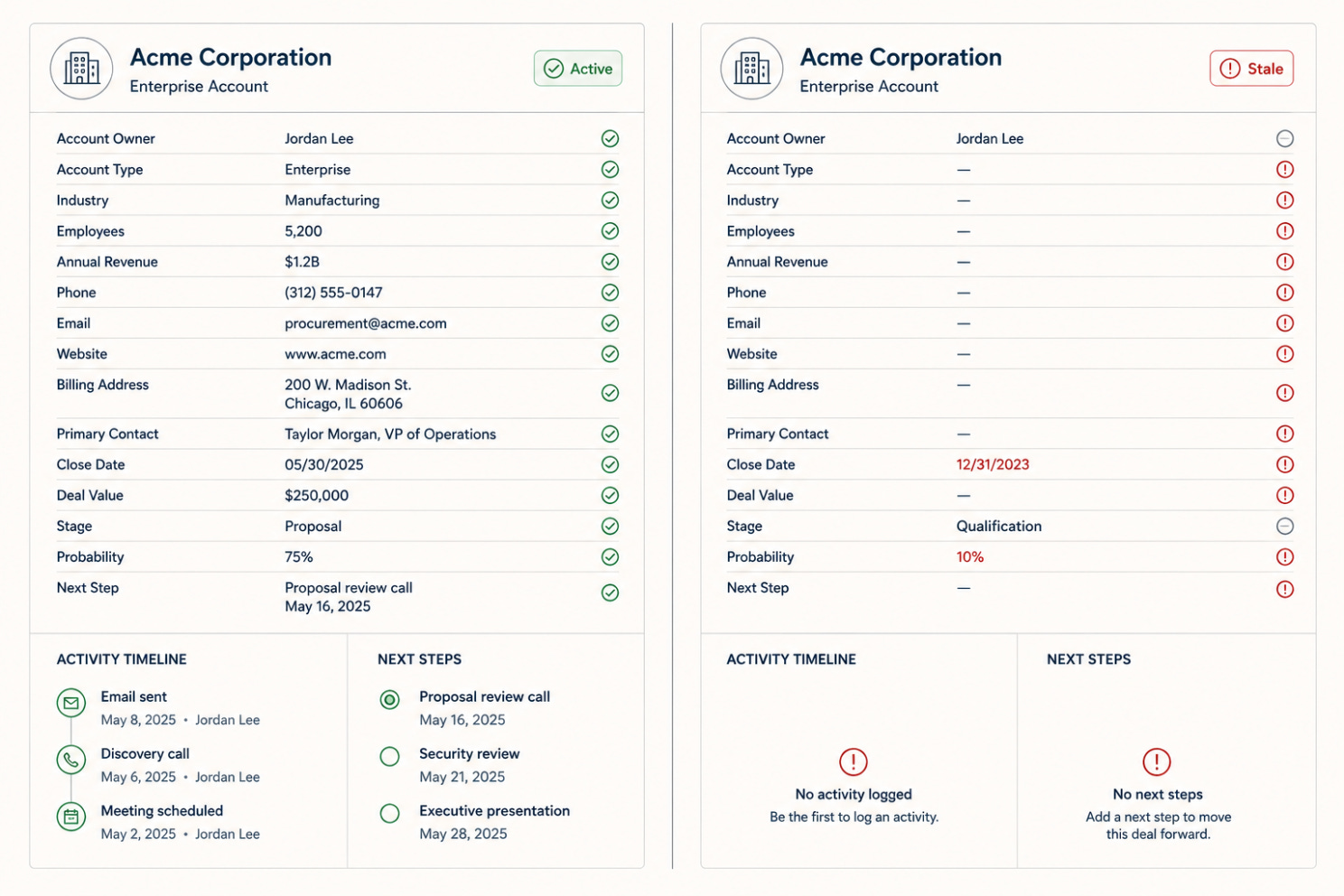
Pipeline hygiene — keeping every opportunity in the CRM accurately staged, correctly dated, and properly documented — is one of the most consistently broken disciplines in enterprise sales. According to HubSpot’s State of Sales report, reps spend up to 21% of their working week on CRM data entry alone. Forrester puts the total administrative burden at nearly 14 hours per week per rep. That is not a productivity problem. That is a structural one.
The incentive is misaligned by design. Reps are judged on revenue, not data quality. Updating a stage, refreshing a close date, logging a next step — none of that moves them closer to quota. So, it gets done because a manager asks, because the QBR is on Friday, because the dashboard turned red. The discipline is extrinsic, and it decays without constant pressure.
The context problem makes it worse. To update an opportunity correctly, a rep needs to synthesise last Tuesday’s email, a recorded sales call, a contract in legal review, a Slack thread with the SE, and a tentative calendar invite from the CFO. Five systems. The CRM sits downstream of all of them — and nobody has time to reconcile it in real time.
This is the job Agent force was built to solve next.
What Agent force Attempts
The pitch is genuinely compelling. An agent that passively monitors call recordings, reads emails through a connected mailbox, watches calendar activity, and tracks document workflows — then proposes opportunity updates back to the rep. Stage moved. Close date adjusted. Next step logged. The rep approves, edits, or declines. The CRM stays accurate without the rep ever manually opening it.
Agentforce’s Sales Management Agent does exactly this — reviewing emails, notes, and call transcripts through Einstein Conversation Insights and suggesting or automatically updating fields inside Pipeline Inspection. Early production deployments report real wins on the straightforward layer: automatic activity logging, contact enrichment, email summarisation. Reps are reclaiming an hour or two per week. That is a genuine improvement and worth acknowledging.
Where It Runs Into Trouble
The harder task — advancing an opportunity stage based on multi-source signals — is where the gap becomes visible.
Salesforce’s own CRM Arena Pro benchmark, published by Salesforce AI Research in June 2025, is the most candid public evidence available. Leading AI agents achieve 58% success on single-turn business tasks — look up a close date, retrieve an account field. That number drops to 35% the moment the task requires multi-turn reasoning: read the last three emails, cross-reference the activity history, determine whether the stage should advance.
In practice, this shows up as drift. An agent reads an email saying, “we’re aligned on terms” and proposes Stage: Negotiation. But the contract is unsigned, the CFO hasn’t responded, and the technical evaluator is still unconvinced. A competent rep holds all of that in context and says, “not yet.” The agent pattern-matches on the most recent strong signal and moves forward anyway — directionally wrong nearly half the time on complex deals.
The reason is architectural, not a matter of model quality. Today’s agents react — they retrieve, respond, and complete a turn. What they don’t do is hold a structured model of the deal across multiple turns, reason forward about whether a proposed action will still make sense three steps later or refuse to commit when the evidence is genuinely inconsistent.
That planning layer is what separates a competent sales rep from a reactive one. And it is precisely what is missing.
The early verdict on Agent force and pipeline hygiene is bimodal: winning on activity capture and contact enrichment, drifting on stage advancement and forecast accuracy. Valuable enough to deploy for the first half. Not yet ready to be the system of record your forecast depends on.
The question that follows naturally is: if agents struggle here — on a job that is structured, high-volume, and data-rich — what happens on the jobs that are genuinely less defined?