Is Agentforce's SDR Agent Qualifying the Right Leads — Or Just the Easy Ones?


Only 13% of marketing leads ever become sales-ready. Agentforce was built to fix that. Here is what the evidence actually shows.
87% of marketing-qualified leads never become sales-qualified.
Let that sit for a moment. Marketing spends budget, runs campaigns, drives form fills — and the average enterprise converts just 13% of those leads into something a sales rep will actually pursue. The other 87% get ignored, expire, or die in a queue somewhere between the marketing automation tool and the CRM.
This is not a marketing problem or a sales problem in isolation. It is a handoff problem. And it has been expensive for long enough that most enterprises have stopped being surprised by it.
The speed dimension compounds it further. Research consistently shows that responding to a new lead within the first hour increases conversion odds sevenfold compared to a 24-hour response. Yet most enterprise sales teams take hours — sometimes days — before a qualified lead gets a human reply. By then the intent signal has cooled, the competitor has already booked a call, and the opportunity is gone.
This is the job Agentforce’s SDR Agent (Sales Development Representative — the role responsible for qualifying and routing inbound leads) was purpose-built to fix.
What the SDR Agent Does
The Agentforce SDR Agent is built natively inside Sales Cloud. It engages inbound leads the moment they arrive — asking contextual qualification questions around budget, use case, timeline, and authority. It scores leads against the Ideal Customer Profile (ICP) — a defined picture of the type of company and buyer most likely to convert — using Einstein Lead Scoring, Salesforce’s built-in AI scoring model, then routes qualified ones to the right rep based on territory, skillset, and real-time availability, and books meetings automatically. It logs everything back to the CRM and operates 24/7 across email, web chat, and Slack.
The early production evidence is genuinely compelling on the volume layer. VTT Technical Research Centre of Finland deployed Agentforce’s SDR Agent to handle inbound lead engagement — a task that previously took their SDR team hours or days — and reported connecting with nearly every single inbound lead. Speed-to-lead, which had been a chronic bottleneck, effectively became a solved problem.
On structured, high-volume, inbound-heavy pipelines — where leads arrive through form fills, content downloads, or campaign responses — the SDR Agent is doing real work. Routine qualification, instant response, clean routing. That is a meaningful operational improvement.
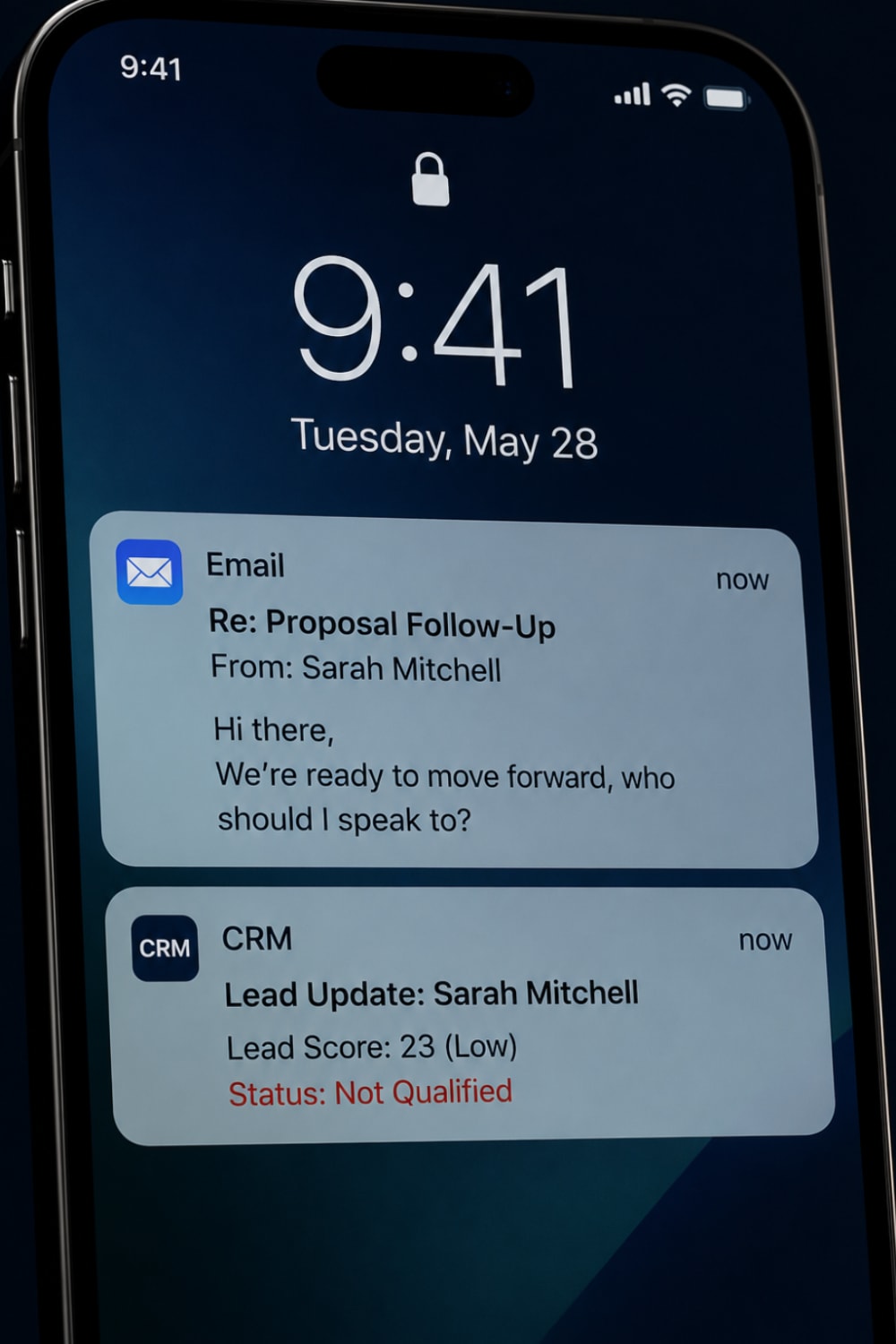
Where the Agent Struggles
The harder problem is what happens when a lead does not fit neatly into a scoring model.
Complex B2B leads rarely arrive clean. A director-level contact from a Fortune 500 fills out a form but uses a personal email. A prospect from an account already in late-stage negotiation submits a separate inquiry under a different business unit. A lead scores low on firmographics but their engagement pattern — three product page visits, a pricing page, a demo request — signals high intent that the model has not been trained to weight correctly.
These are not edge cases. In enterprise B2B, they are the norm. And Agentforce’s SDR Agent, which excels at pattern-matching against known signals, has no reliable way to reason across ambiguous, multi-signal scenarios the way an experienced SDR would.
The CRMArena-Pro benchmark result — 58% on single-turn tasks, 35% on multi-turn reasoning — applies directly here. Qualifying a straightforward inbound lead is a single-turn task. Evaluating a complex prospect with incomplete data, conflicting signals, and multi-stakeholder context is a multi-turn reasoning problem. The agent was not built for the second one.
There is also a data dependency issue worth naming. Einstein led scoring requires sufficient historical conversion data to train the model — teams without clean lead history often find that scores are unreliable or simply absent. Only 44% of organisations actually score their leads at all, which means a significant portion of Agentforce SDR deployments are running on a scoring foundation that does not yet exist.
The pattern holds. On volume, speed, and structured qualification, Agent force’s SDR Agent is a genuine step forward. On the nuanced, ambiguous, multi-signal leads that often represent the highest-value opportunities, it still needs human judgement in the loop.
The 13% MQL-to-SQL average is not a volume problem. It is a qualification accuracy problem. And accuracy — on the leads that actually matter — is still waiting for a better answer.
Sources: Landbase Lead Qualification Statistics 2026 · DOJO AI MQL to SQL Conversion Guide 2026 · Data-Mania MQL to SQL Benchmarks 2026 · Salesforce Agentforce SDR Agent · VTT Technical Research Centre Case Study · Salesforce AI Research CRMArena-Pro, June 2025